
Binance KYC Verification
You’ve probably come across the term “KYC” on online financial platforms. As controversial as it maybe it’s something crypto traders have learned to embrace as the cost of operating on a regulated platform.
The reality is you as Binance user intend to use Binance to its full capacity; full withdrawal limits, welcome bonuses, staking, p2p trading and all other services that Binance offers, KYC is not optional. If anything it’s the gateway.
This detailed guide will go through everything you need to know about Binance KYC verification; what exactly it is, its purpose, how to complete without any issues & what happens if you don’t complete it. Additionally, we’ll cover certain tips that most guides tend to skip, since getting it right from the beginning will save you lots of frustration going forward.
What Is KYC and Why Does Binance Require It?
KYC simply means “Know Your Customer.” It is more of a regulatory requirement that financial institutions & crypto exchanges must adhere to in a majority of jurisdictions around the world. The process typically involves verifying one’s identity in order to prevent instances of financial crimes like money laundering, fraud & terrorist financing.
Binance being the largest crypto exchange in the world by trading volume, still undergoes regulatory scrutiny in many jurisdictions. And in an effort to maintain its operating licenses and continue serving millions of users globally, it has to conform to the Anti-Money Laundering (AML) and KYC regulations that are put in place by financial authorities.
And this doesn’t apply to Binance only. All major crypto exchanges; Coinbase, OKX, Kraken, Bybit, all require identify verification. The olden days of fully anonymous crypto trading on crypto platforms are long gone. What you can be able to get away with on DeFi on-chain may be a different conversation, but on Binance, KYC is mandatory.
Binance comes with multiple KYC levels; Basic & Advanced verification, and each have different limits and special features. Normal users only need to complete the basic KYC in order to access various features on the platform, but advanced KYC rewards crypto users & traders with higher withdrawal limits & extra products.
Binance KYC Levels Explained
Comprehending the difference between verification levels enables you to know exactly what to complete and why.
Unverified Account
If you haven’t completed KYC, your Binance account is essentially a read-only shell. You still have the privilege to browse the platform and maybe make small crypto-to-crypto transactions, but more importantly, you’re locked out of most crucial features. Fiat deposits, higher withdrawals, P2P trading, and welcome bonuses all need at least the Basic KYC verification.
Basic Verification (KYC Level 1)
This is the standard level most users finish during the sign up process. It requires:
- Personal info such as (full name, date of birth, residential address)
- A govt-issued photo ID (passport, national ID card, or driver’s license)
- A facial recognition / liveness check
With Basic verification, you activate the following:
- Standard withdrawal limits (usually up to 200 BTC per day; this is more than enough for advanced traders)
- Access to fiat on-ramps and off-ramps (financial bridge between trad banks & blockchain systems)
- Qualification for welcome bonuses and special promo campaigns
- Complete access to spot trading, Binance Earn, and other core products
- P2P trading
Advanced Verification (KYC Level 2)
Advanced verification goes even further and involves extra documentation like proof of address (utility bill, bank statement) or proof of income in certain regions. It activates a higher withdrawal limit and gives access to special institutional or higher-tier products.
For plenty of retail crypto traders, the basic verification is all you’d require to use Binance fully and effectively.
How to Complete Binance KYC: Step by Step
Here’s the complete guide so you know exactly what is expected at each stage:
Step 1: Log into Your Binance Account
Navigate to your account dashboard. In case you haven’t registered yet, go do that and make sure to use the Binance referral code BONUS369 during the registration process to unlock a $600 welcome bonus and 20% lifetime discount on all trading fees. However, to activate these rewards you’ll be required to complete KYC.
Step 2: Navigate to Identity Verification
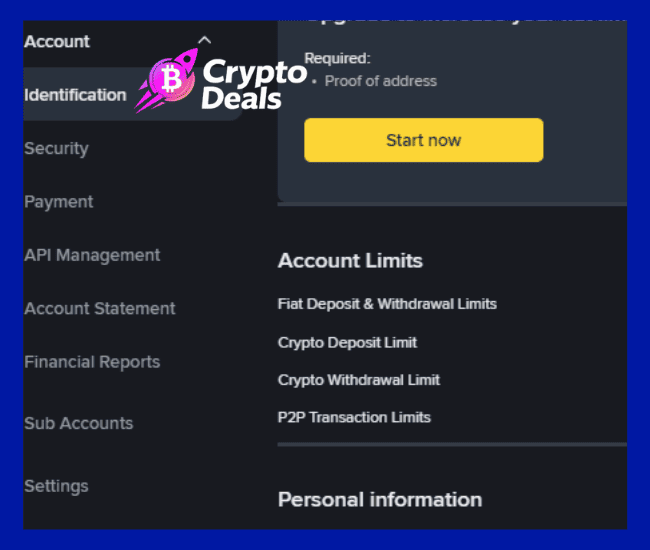
On your profile icon in the top-right corner. Navigate to “Account” from the dropdown menu, then “identification” which will typically be on the bottom left of the page. Binance may also prompt you with a banner when you first log in.
Step 3: Select Your Country of Residence
Choose the country where you’re currently located. It is not necessarily your country of citizenship, however, these two are often the same. The document types accepted vary according to one’s region.
Step 4: Enter Your Personal Information
Enter your legal name just as it appears on your ID document. It should have the same spelling, and follow the same order. Proceed to fill in your date of birth and residential address correctly. In case there’s any inconsistency between what you enter here and what’s present on your ID document then the KYC will fail.
Step 5: Choose Your ID Document Type
Binance accepts these document types:
- Passport: Usually the fastest and most reliable option at a global level
- National ID Card: Accepted in most countries
- Driver’s License: Accepted in plenty of regions
All in all, passport is the gold standard. It’s widely recognized, has crystal clear biometric data, and will pass through verification the fastest.
Step 6: Upload Your Document Photos
You’ll be required to upload photos of your document; front and back where it’s applicable. And this is the point, where many users run into delays. Checkout the tips section below for getting things right on the first attempt.
Step 7: Complete the Liveness Check
The liveness check is typically a short facial recognition step where a user is asked to look at their camera and follow the requests on screen such as; turning your head slowly, blinking, or both. This is how you confirms you’re a real person submitting your own documents as opposed to someone making use of someone else’s identity.
Ensure you do this in an environment with enough light & when facing the light source (not with a bright window behind you), or with your face unobstructed. Additionally, you shouldn’t have hats, sunglasses, or any heavy filters on.
Step 8: Submit and Wait
Upon submission, Binance’s verification system will processes your documents. A majority of users get approved in a span of a few minutes to a few hours. However, during periods of high traffic, for example the beginning of a bull run when hundreds of new users are signing up at the same time, it could take up to 24 hours.
Once verified, you’ll receive an email notification as confirmation. Check your Rewards Hub on time after approval so that you can start working through your welcome bonus tasks.
Common Reasons KYC Gets Rejected (And How to Avoid Them)
Binance’s automated verification system is absolutely accurate, however it does reject submissions that don’t meet its standards. Here are a couple of reasons & the solutions:
Blurry or low-resolution photos. The verification system should be able to read the text and biometric data on your ID clearly. In an instance your camera provides low light, ensure you find a brighter spot. Ultimately, natural daylight is ideal. You can tap your screen fully focus on the doc before capturing.
Glare on the ID surface. Shiny plastic ID cards and passports that have laminate covers and tend to catch light and will create reflective patches that easily obscure text. Tilt the card a bit away from the overhead lighting, or identify a spot with indirect light. Don’t take a picture of your ID on a glass table that has a light source beneath it.
Cut-off document edges. All the four corners of your ID should be visible in the photo frame. Leave some background visible while at it.
Name mismatch. Fill in your name in the personal info form exactly as it appears on your ID, and should also include middle names if they’re on the document. Avoid any Abbreviations, nicknames, or reordered names .
Expired ID document. Ensure that the ID you’re uploading is valid. Binance doesn’t accept expired documents.
Using screenshots or photocopies. The photos of the physical document should be taken directly. Avoid any screenshots of ID photos from other apps and scanned photocopies.
In case your ID has a holographic overlay that may misrepresent a photo, take photos at a slight angle under controlled lighting. The goal here is to capture all the printed text clearly while lessening the hologram interference. Most modern smartphones are able to deliver on this.
Is It Safe to Submit Your ID to Binance?
This is a common question, and it’s a fair one. Uploading photos of your government-issued ID on any online platform needs a baseline of trust.
Here’s something you should know. Binance stores its KYC data under enterprise-grade encryption and adheres to data protection regulations across its operational jurisdictions. The platform has processed KYC for millions of users at a global capacity. Their security infrastructure is robust, more than most financial platforms handling personal & sensitive data.
The big risk here actually is the phishing. The possibility of people getting tricked into uploading their KYC documents to fake Binance websites that are put in place to harvest personal data. And this is why making sure you’re on the legitimate (https://www.binance.com) before you begin the verification process is crucial.
For a legitimate KYC submission on the real Binance platform, the risk factor is quite comparable to submitting your ID to any trad financial institution like Banks, brokerages, and payment processors that all need the same information.
Note that Binance will never inquire for your KYC documents through email, Telegram, WhatsApp, or any channel outside of its platform. In case someone contacts you claiming to be Binance support and asks for your ID documents, it’s a scam.
Andrzej Wiśniewski Quick Tip

Andrzej Wiśniewski is a Kraków-based crypto trader and on-chain analyst who’s been active in the space since the 2017 bull cycle.
“Here’s something that has affected people I know: they complete KYC on Binance with an ID that’s about six months from expiring, and think it won’t affect anything. Then when their ID expires and they’re attempting to update it, Binance will need a new verification submission. It may not be a big deal, but it may temporarily lock particular features while the new submission processes. In case your ID is within 12 months of expiry, maybe consider whether it’s worth completing KYC with a newer document right from the start. It’s a minor detail, but has substantial impact.”
What Happens If You Don’t Complete KYC?
Using Binance without KYC isn’t really an option for any user who wants to make use the platform seriously. Here’s what you’ll potentially be missing:
Withdrawal limits: Unverified accounts are subjected to extreme restrictive withdrawal limits. Even crypto withdrawals are capped at very low amounts.
No fiat on-ramps: You won’t be able to deposit or withdraw fiat currency without completing identity verification. That typically means no bank transfers, no card purchases, no local payment methods. So essentially, you’re stuck with crypto-only mode, which may limit how you can get your assets in and out.
No P2P trading: Binance’s p2p marketplace; where users can buy and sell crypto directly with other users by leveraging local payment methods also requires KYC in order to trade.
No welcome bonuses: In case you signed up with binance promo code BONUS369 or any other code, your bonus tasks may require you to verify your Binance account. An unverified Binance account doesn’t have the privilege to access the Rewards Hub.
No Binance Earn access: Majority of staking and savings Binance products also need KYC.
The bottom line is: an unverified Binance account puts you at a disadvantaged position. KYC is the factor that unlocks the platform.
KYC and Privacy: Its Essence
Many people care immensely about financial confidentiality. The original vision behind Bitcoin was p2p electronic cash without any existing intermediaries or identity checkpoints. KYC is a bit contradictory with that vision.
Centralized exchanges that run under traditional financial regulatory frameworks need identity verification. For those looking for max privacy, decentralized exchanges (DEXs) like Uniswap, dYdX, and others do permit trading without KYC; however, they also come with their own tradeoffs in terms of liquidity, fiat access, and user experience.
For most users looking for exposure to a huge range of assets, competitive fees, fiat on-ramps, and institutional-grade security infrastructure, the minor compromise of completing KYC on a platform like Binance is worthwhile. Ultimately, centralized & decentralized are barely mutually exclusive. Many seasoned crypto users take advantage of both.
Frequently Asked Questions
Q: How long does Binance KYC verification take?
For plenty of users, KYC is completed in a few minutes to a few hours. Nevertheless, during high-traffic periods it can take up to 24 hours. You’ll receive an email confirmation when your verification status is reported.
Q: What documents does Binance accept for KYC?
Binance typically accepts passports, national ID cards, and driver’s licenses. However, passport document is the best option for fast verification globally.
Q: Can I use Binance without completing KYC?
Yes. You can create your unverified Binance account but note that you’ll have very limited functionality. Additionally, withdrawal limits are restricted, fiat services are blocked, and most important features including Earn products, P2P trading, and welcome bonuses need verification. For any practical use of Binance, KYC is crucial.
Q: What if my KYC verification gets rejected?
You’ll just need to review the reason your KYC was rejected. (Binance usually shares this in your verification section or via email). Go on and fix the issue, most times being photo quality or a data mismatch & submit once again. Most rejections are resolved on the second attempt if the corrections are made.
Q: Is my personal data safe with Binance?
Absolutely. Binance stores KYC data with enterprise-grade encryption and adheres with the present data protection regulations. The major risk to avoid is submitting your data to phishing sites that mimick Binance. Verify that you’re on the official Binance platform before beginning the KYC process.
Q: Can I trade crypto on Binance before completing KYC?
You may get away with doing limited crypto-to-crypto trading with minimal withdrawal limits on an unverified account, but the whole encounter is severely restricted. For quality trading activity, completing KYC should be considered
Q: Does Binance share my KYC data with governments or third parties?
Binance, like all regulated financial institutions, may at time be required to share user data with law enforcement or regulatory bodies following a request. This is just standard practice across all compliant exchanges and any traditional financial institutions. Checkout the privacy policy on Binance for more info.
Q: What is the difference between Basic and Advanced KYC on Binance?
Basic KYC (Level 1) involves only the standard identity verification and activates full retail trading functionality. Advanced KYC (Level 2) covers extra documentation and unlocks higher withdrawal limits and access to special premium products. However, most retail users only need Basic verification.
Conclusion
Binance KYC verification is one of those factors that’s much less agonizing than its reputation implies. All you need is five minutes of preparation; have good lighting, all documents in hand, and enter personal info accurately. It’s as easy as it gets.
Ensure you get it done early, get it done right, and it’s something you won’t have to worry about again. Binance will give you automatic access to full withdrawal access, fiat on-ramps, welcome bonuses, staking, and one of the best, robust trading ecosystems in the crypto space.
If you’re yet to register, remember to use the Binance referral ID BONUS369 when you sign up. It only takes you five seconds to enter and it rewards you with 20% lifetime discount on all trading fees plus eligibility for up to $600 in welcome bonuses. Once your KYC is cleared, navigate to rewards Hub and begin working through the bonus tasks before they expire.
Last edited: 5/5/2026
Kraków-based trader active in crypto markets since the 2017 bull cycle. Andrzej specialises in on-chain analysis, exchange mechanics, and risk management. I help everyday crypto traders navigate the crypto space with confidence in order to make informed decisions.
Disclaimer: This article is for informational purposes only and does not constitute financial or legal advice. KYC requirements, verification processes, and platform features are subject to change. Always refer to Binance’s official documentation for the most current information.