

The USD.AI (CHIP) is one of the most captivating new projects to be available on Binance’s HODLer Airdrops. Fundamentally, its a permissionless crediting protocol designed particularly to finance AI infrastructure, where GPU operators are able to tokenize their hardware as collateral and immediately borrow capital. And now with its CHIP token accessible through BNB‑based retroactive rewards on Binance, the project is delivering a fascinating mix of DeFi mechanics, real‑world collateral, and sufficient exposure to the AI boom. All of it being wrapped in an airdrop for active BNB holders.
What USD.AI (CHIP) Is All About
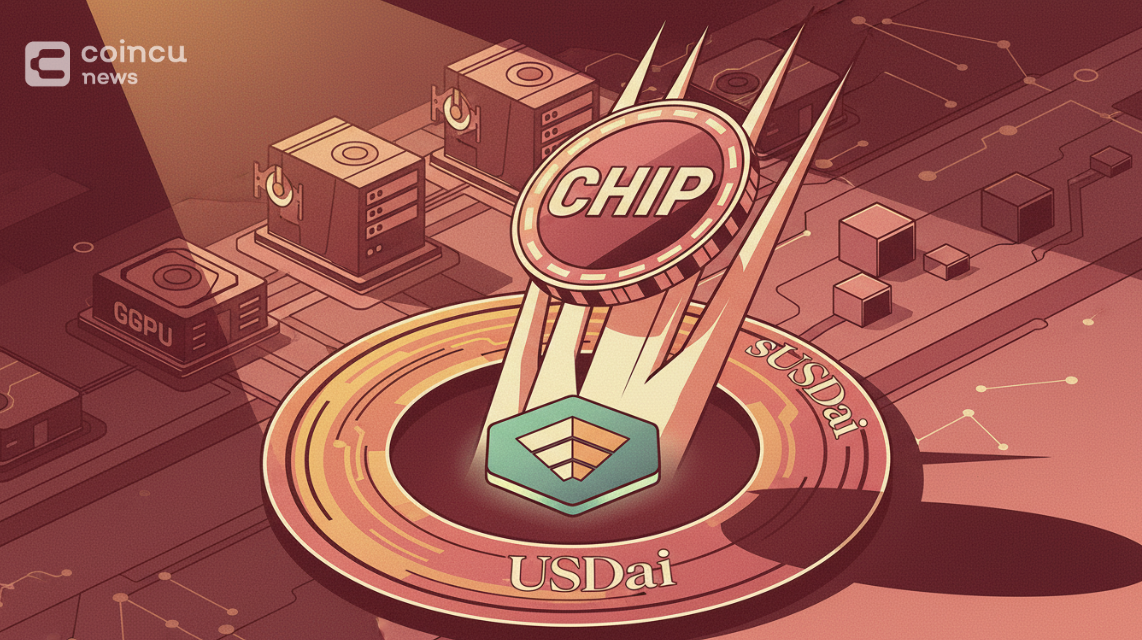
Essentially, USD.AI is a decentralized lending protocol that was built to finance AI infrastructure by tokenizing physical GPUs as on‑chain collateral. Rather than just depending solely on traditional banks or strict private lenders, AI firms and GPU operators can lock in their hardware into the protocol, mint a stablecoin‑like asset (USDai), and have instant access to liquidity.
So, CHIP is the governance and utility token of USD.AI, rewarding holders with privileges such as voting power over protocol parameters such as risk models, collateral factors, and fee structures. Practically, CHIP is merely a speculative ERC‑20; it is the coordination layer that grants power to the community to conduct how AI infrastructure is capitalized on‑chain.
Apart from governance, CHIP is involved in staking‑based incentives and yield‑sharing mechanisms, coordinating the interests of lenders, GPU operators, and govt‑focused long‑term holders. For any crypto‑native investors, CHIP becomes more of a “meta‑exposure” token to the AI infrastructure value chain, as opposed to being a plain infrastructure operation.
The protocol offers non‑recourse loans anchored by GPU infrastructure and asset‑level cashflows, hence providing investor’s exposure to liquid, transparent, and tradable credit products that are backed by income‑generating compute assets. This real‑world functionality differentiates USD.AI in the DeFi lending space.
How USD.AI Works: From GPUs to Stablecoins
At the root of it, USD.AI offers a dual‑token architecture that’s curated around AI‑hardware‑backed lending. The protocol by itself issues USDai; a stablecoin that’s backed by PYUSD and also mintable with PYUSD, USDC, or USDT directly on app.usd.ai. Additionally, its also redeemable at any point in time with no yield. Its yield‑bearing counterpart, sUSDai, accumulates interest from the lending activities and currently has a 6.84%.
Here’s how it works
- The GPU operators lock their rigs inside the protocol, and the platform values the hardware following the standardized underwriting criteria (location, age, redundancy, and real‑world performance).
- The protocol then provides USDai against that collateral, allowing the operator to acquire capital‑efficient liquidity without the need to sell the hardware.
- The USDai loans are capitalized by liquidity pools supplied by third‑party depositors, who earn their yield in return for providing the required capital; idle capital earns 4.5% through PYUSD, while deployed capital amasses interest from borrowers like GPU operators and neoclouds.
- The sUSDai at the core of it is the yield‑bearing wrapper: when users deposit USDai into designated pools, they get sUSDai, which slowly grows in value as loan interest is paid back. This takes a “money‑market‑style” model, but with the novelty that the fundamental loans are offered by physical machines running AI workloads. The Redemptions take a fixed 30‑day schedule.
- Since every origination, collateral position, and loan status is accessible on the USD.AI dashboard, the protocol focuses on transparency and accountability. For any regulated organizations and institutional‑minded investors, the promise of on‑chain visibility into real‑asset loans makes all the difference from traditional financing.
Why CHIP Fits Perfectly Into Binance’s Ecosystem
When Binance takes on a project like USD.AI (CHIP) onto HODLer Airdrops, it’s indicating that the token is in line with Binance’s long term vision for yield‑oriented, “infrastructure‑linked” crypto projects. The 25 million CHIP airdrop depicts 0.25% of the total 10 billion CHIP supply, which is somewhat modest and implies a long‑term growth‑oriented distribution as opposed to a mere pump‑and‑dump.
CHIP’s listing on Binance spot pairs such as CHIP/USDC arms it with instant liquidity and visibility. On the other hand, HODLer Airdrops mechanism guarantees that existing BNB “HODLers” who already make use of Binance’s Simple Earn and On‑Chain Yields products get automatic exposure. This retroactive‑reward model is lucrative as it doesn’t require one to perform any complex on‑chain actions; if they were already earning yield on BNB, they will already be qualified.
From a wider perspective, USD.AI’s niche; AI‑infrastructure finance, is highly interdependent with the bigger narrative around GPUs, AI data centres, and the on‑chain tokenisation of real‑world assets. When you add CHIP to the HODLer roster, Binance allows its user base to gain exposure to this landscape without the need to force users to dive into more complex, fragmented DeFi protocols.
USD.AI’s Impressive Traction and Metrics
USD.AI isn’t just theoretical. It’s keen on providing real results. sUSDai as of the writing of this ranks 10th among all yielding stablecoins following TVL (5th excluding T‑bill stables), with over $12B traded and $15M in yield pay outs. The protocol prides itself for $106.7M in active loans (covering executed and escrowed), showcased by a recent $26.8M deal with Crucible Capital which happens to be its biggest loan to date and the 4th consecutive monthly high‑water mark
The loan pipeline is quite robust with about $214M in signed term sheets, in addition to $1.2B in approved facilities for partners like Sharon AI and Qumulus AI. Its Yield sources are varied; idle capital through PYUSD (4.5%) and implemented capital from loanees; making it a irresistible choice for yield farmers looking for AI‑backed returns. These metrics highlight USD.AI’s momentum in linking up DeFi with valuable AI infrastructure.
Andrzej Wiśniewski Quick Tip

Andrzej Wiśniewski is a Kraków-based crypto trader and on-chain analyst who’s been active in the space since the 2017 bull cycle.
“The most effective mental models for comprehending USD.AI is to approach it not as pure “AI token” but rather a yield‑focused infrastructure protocol whose fundamental collateral happens to be GPUs.When testing USD.AI, ask: 1. What “really” is the real‑world risk factor of the collateralized GPUs (location, counterparty, uptime, market value drift)? How clear the financing is process and how noticeable are the loan books on‑chain (e.g., $106.7M active loans)? 2. “How does the yield on sUSDai really compare to the protocol’s risk taking and capital‑efficiency metrics? “
This more “credit‑fund” style method of evaluation enables you to avoid getting caught up in hype and rather view CHIP as a token that derives value if the underlying lending business thrives profitably and remains well‑funded.
How The CHIP HODLer Airdrop Works
Binance’s HODLer Airdrops program is built to compensate long‑term BNB holders with additional token exposure relying on historical snapshots of their BNB balances. For USD.AI (CHIP), this system is retrospective and passive hence allowing users who’ve already subscribed their BNB to Simple Earn (Flexible and/or Locked) and/or On‑Chain Yields during the elogibility window become qualified instantly.
The key parameters are:
- Eligibility window: 2026‑04‑13 00:00 UTC to 2026‑04‑15 23:59 UTC.
- Reward calculation: Binance utilizes multiple snapshots of user balances derived from Simple Earn and/or On‑Chain Yields on that specific period.
- Reward cap: There’s no user can get more than 4% of the total standard BNB pool, so exceedingly large BNB whales are capped.
- Distribution: Qualified users are rewarded 25 million CHIP distributed to their Spot Accounts in 5 hours from the official announcement.
This approach discourages last‑minute rush farming and alternatively compensates continued participation in Binance’s yield products. Since the program is retroactive, many users may not even recognize they’re eligible until they check their Spot wallets after the official announcement.
Even though the CHIP HODLer Airdrop is an exceptional opportunity, it’s crucial to approach it as a bonus rather than a core investment thesis. If as a user you’re already earning on BNB, the airdrop is just a “bonus token” with restricted direct cost. Do not substantially alter your fund‑allocation plan; confirm traction like sUSDai’s $12B volume and $214M pipeline initially. After you’ve received CHIP, make a decision whether it fits your long‑term portfolio based on the core fundamentals (e.g., $106.7M loans
That is to say, the HODLer Airdrops system works best as a by‑product of a rational BNB‑yield function, not entirely as a reason to chase more risky leverage just to gain more tokens.
CHIP Supply, Tokenomics, and Economic Design
Understanding CHIP’s tokenomics is important before writing or even investing in it. The protocol has a stable total and max supply of 10 billion CHIP, with 2 billion CHIP being distributed at Binance listing (20% of total supply). That leaves a huge portion of the token supply restrained for long‑term incentives, governance participation, and ecosystem growth.
The 25 million CHIP assigned to HODLer Airdrops showcases just 0.25% of the total supply, which is moderately conservative in comparison to many meme‑coin‑style airdrops. When clarifying this, it’s crucial to think of it as a trailblazer reward rather than a major distribution channel; plenty of future supply will be conducted through governance motions and staking‑based emissions.
CHIP’s utility is deliberately pronged:
- Governance: Holders get to vote on collateral constraints, fee structures, and new product launches.
- Staking: The incentive programs lock CHIP in order to earn protocol‑level rewards or fee‑sharing streams.
- Protocol alignment: Teams and ecosystem partners get rewarded with CHIP‑based grants or incentives attached to real‑world growth metrics like loan originations.
Real‑World AI Infrastructure: Where USD.AI Fits
USD.AI is placed at the intersection of two huge trends: the AI compute boom and the tokenization of real‑world assets (RWA). As AI models continue to become more complex, the demand for GPU clusters is on the rise, and traditional lenders are battling with speed, clarity, and capital efficiency.
USD.AI’s value proposition:
- Speed and efficiency: By automating underwriting and collateralization on‑chain, the protocol turns GPU hardware into liquid capital at a faster speed than any other bilateral lending arrangements.
- Transparency: Every loan and collateral position can be accessed on the protocol dashboard, which reduces information disparity among lenders and operators.
- Global reach: USD.AI provides its services to deployments all over North America, Europe, Australia, and Southeast Asia, with some loanees such as Qumulus AI and Sharon AI driving a $214M+ pipeline.
When you look at it from a crypto‑media perspective, this narrative is quite “friendly”: a DeFi protocol that funds the real hardware behind the AI revolution, as opposed to just trading AI‑themed tokens.
Frequently Asked Questions (FAQs)
Q: What is USD.AI (CHIP)?
USD.AI at its core is a permissionless lending protocol that funds AI infrastructure by allowing GPU operators tokenize their hardware as security. CHIP is its governance and utility token, that’s utilized for voting, staking, and any protocol rewards.
Q: How did I get CHIP on Binance?
If you’re a user on Binance and you subscribed BNB to Simple Earn (Flexible and/or Locked) and/or On‑Chain Yields in the periods between 2026‑04‑13 00:00 UTC and 2026‑04‑15 23:59 UTC, then you were automatically qualified for the CHIP HODLer Airdrop. Rewards may have been distributed to your Spot Account in a span of 5 hours after the announcement.
Q: What are USDai and sUSDai?
USDai is a stablecoin that’s secured by PYUSD, mintable/redeemable with PYUSD/USDC/USDT on the app.usd.ai . sUSDai also bears yields at 6.84% APY (with a target of 10‑12%), from its idle PYUSD (4.5%) and interests coming from borrowers.
Q: What is the total supply of CHIP?
The total supply of CHIP is about 10 billion. At Binance listing, 2 billion CHIP were distributing (20% of total supply), and 25 million CHIP were assigned to the HODLer Airdrop.
Q: How does USD.AI differ from normal DeFi lending?
Plenty of DeFi lending depends on crypto‑native assets (ETH, BTC, etc.) as collateral while USD.AI focuses particularly on GPU hardware powered AI workloads through its non‑recourse loans. This rewards it a strong “real‑world” concept and attaches its credit risk to tangible machines as opposed to purely token‑price volatility, with $106.7M active loans.
Q: Is CHIP only available on Binance?
While CHIP is listed on Binance, the token’s smart contracts are also launched on Ethereum and Arbitrum, so CHIP theoretically can trade on other crypto exchanges and DeFi platforms. Nevertheless, Binance warns users to be wary of scams and should only trade official contracts.
Q: Do I need to keep my BNB locked to keep the CHIP?
Absolutely not. Once distributed, CHIP will sit in your Spot Account, and even your BNB subscription status barely affects your existing CHIP holdings. Nonetheless, future HODLer Airdrops may need active participation in Simple Earn or On‑Chain Yields.
Q: What’s USD.AI’s traction?
The sUSDai takes the top‑10 position by TVL among yielding stablecoins, by having a rich pool of; $12B+ traded, $15M yield paid, $106.7M in active loans (e.g., $26.8M Crucible deal), and $214M+ pipeline ($1.2B approved for Sharon/Qumulus AI).
Q: Is CHIP suitable for beginners?
CHIP is quite newbie‑friendly in terms of custody, but it still happens to be a high‑risk, speculative asset. Beginners should approach it as a small, discretionary allocation and not bet more than they can afford to lose.
Last edited: 5/10/2026
Source: https://www.binance.com/en/support/announcement/detail/c8d2380a71ee4b56980cf7798d2e3d8f
Kraków-based trader active in crypto markets since the 2017 bull cycle. Andrzej specialises in on-chain analysis, exchange mechanics, and risk management. I help everyday crypto traders navigate the crypto space with confidence in order to make informed decisions.
Disclaimer: This article is for informational purposes only and is not financial advice. Cryptocurrencies like CHIP are high-risk, volatile assets. Always do your own research (DYOR), consider your risk tolerance, and consult a financial advisor before investing. Past performance does not guarantee future results.