
Last couple of years AI and blockchain technology has invented a new space of decentralized projects that are changing how digital structure is designed and accessed. OpenGradient is one of these developments that’s exclusively focused on building open & verifiable AI infrastructure.
At its core, OpenGradient sets itself up as a network for open intelligence with a goal to build infrastaructure giving AI models the opportunity to be served, trained and verified on decentralized system. The vision here is to make AI more transparent, accessible and open rather than just being fully controlled by centralized entities. This special ecosystem allows for distributed machine learning, decentralized inference and also open source AI tools that easily function across a wide network of participants. This approach supports an up & coming belief that the future of artificial intelligence should adopt a collaborative and community structure rather than being exclusively dominated by closed systems.
The Black Box Problem
There’s a factor that never gets discussed enough: atleast every AI interaction that users have is utterly unverifiable. When one types a query on ChatGPT, Claude or any other AI assistant, and you get a response. That’s the only extent of your oversight. You have no idea which version ran, whether it was fine-tuned in an alternate manner than advertised, whether the response was altered, or if the data used on the background to generate it is truly aligned with what was communicated.
For most consumer use cases like; writing emails; this opacity is okay. Inconvenient, maybe, but fine. However, for financial decisions, healthcare recommendations, legal advice or any high-stakes automated workflow; it becomes a challenge. And a serious one for that matter.
And this issue is only going to get worse as AI agents continue to proliferate. When an AI agent proceeds to execute trades, buy items, or interact with smart contracts on your behalf; the lack of verifiable AI responses/outputs becomes one major vulnerability; and especially if AI blends deeper into decentralized finance & on-chain governance.
This is the specific gap that OpenGradient seeks to fill. Not just another AI chatbot or “AI token” adopting this narrative. A piece of actual infrastructure that’s specifically designed to be fundamental to decentralized AI as Ethereum is to decentralized finance.
How the Verification Actually Works
The technical detail that’s essential to understand here is TEE attestation. A Trusted Execution Environment is a secure, isolated processing area that exists inside a chip that’s typically separate from the rest of the hardware. When AI inference operates inside a TEE, the hardware itself generates a cryptographic certificate that proves a specific computation ran on a specific model, unmodified, and in a safe & secure environment.
OpenGradient picks these hardware attestations and proceeds to settle them on-chain, hence creating a permanent, auditable record. This changes any AI output to something that can be mathematically verified by any user.
The process is done in four steps. First, a developer, dApp, or AI agent presents an inference request and pays in $OPG tokens via the x402 protocol. Then second, specialized GPU and TEE nodes executes the model inside hardware enclaves, and then the secure hardware produces a cryptographic attestation that essentially proves what ran and how. Third, validators proceed to check each result’s TEE attestation at consensus; the network concurs on the verified output before anything can be finalized. The final step is the verified result being settled on-chain as a permanent, auditable record.
The network has already produced over 500,000 cryptographic attestations through TEE-secured nodes. Each one symbolizes an AI inference that anyone is able to audit. It’s not just theoretical. Its working infrastructure.
Real Products With Real Users
One of the things that separates OpenGradient from most infrastructure plays is how it didn’t wait for developers to just build on it. The team focused on shipped consumer-facing products partially as proof of concept & partly to drive actual adoption. The results have been nothing short of exceptional.
BitQuant is specially designed as an AI powered quantitative trading platform and it’s also OpenGradient’s flagship product. It gives users the opportunity to access sophisticated trading trading strategies via natural language engagements. BitQuant combines AI driven analytics, on-chain intelligence, portfolio management tools & automated strategy recommendations into one interface. Something that makes BitQuant special is the fact that its services are powered by OpenGradient’s verifiable AI infrastructure hence giving users the ability to engage with AI generated perspectives while also maintaining trust & transparency.
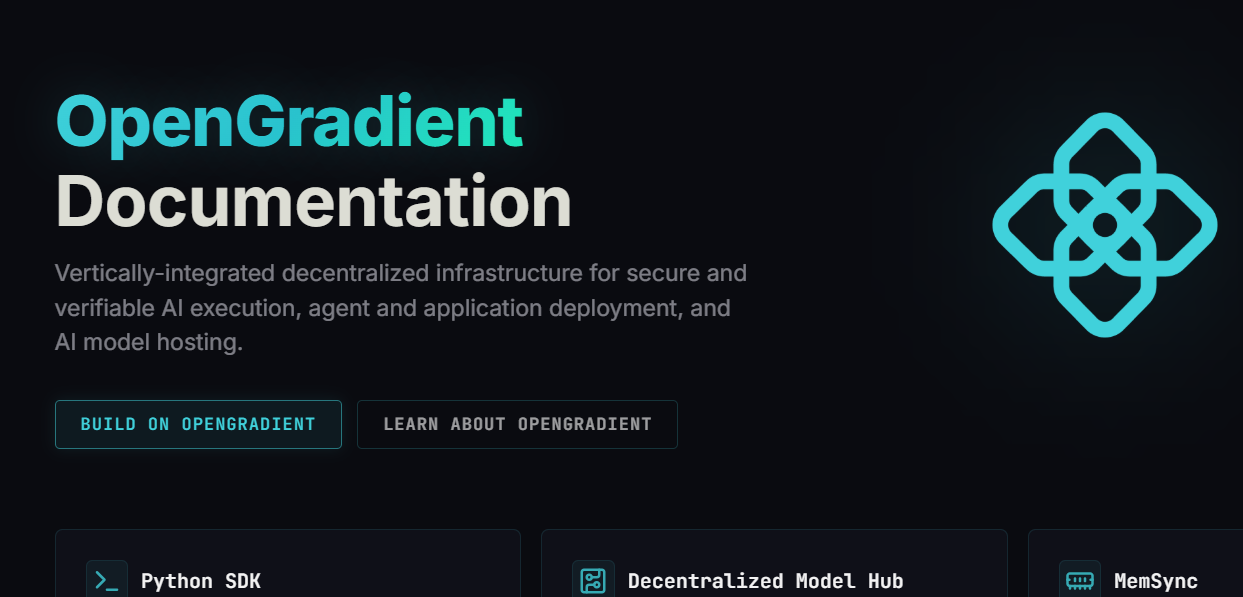
MemSync main goal is to serve as a universal memory layer and particularly for AI agents. It’s quite a simple concept but potentially transformative. Instead of a user having to recreate context when they change applications, MemSync allows for previous preferences, history, & relevant info to move smoothly across AI-powered platforms.
Twin.Fun is an AI digital twin Launchpad under OpenGradient that allows its users to build, interact with, and trade AI generated personas. These digitals twins are able to be modeled after real individuals, influencers and characters hence giving users the privilege to create AI driven representations that can interact with communities in special ways. This concept combines digital identity, artificial intelligence, and tokenized ownership into one single entity.
Finally, there’s the Model Hub which is essentially an open marketplace of verifiable AI models at hub.opengradient.ai. Over 4,500 models from more than 100 third-party developers are accessible for anyone to use or even monetize. For context, when OpenGradient’s April 2026 release mentioned 2,000+ models, the network had only been in public beta for only a couple of months. Since then, it has doubled.
These products showcase how OpenGradient runs as a foundational platform for an increasing range of consumer AI applications; from financial tools to digital identity and persistent AI memory.
The irony in crypto is that most infrastructure projects barely have any users. OpenGradient is going out of its way to not be that project.
The Traction So Far
Numbers can be easy to pick on, so let’s focus on what the data in fact shows. As of May 2026, the network has ran over 3.2 million verifiable inferences, with 1.2 million of those emanating from the April 2026 token launch, therefore indicating acceleration rather than a one-time spike. There are 1.85 million on-chain transactions that are running at roughly 13,000 per day. The ecosystem across BitQuant, MemSync, and Twin.Fun hits over 2 million users across 40+ countries, with 263,500+ unique wallets.
One thing worth noting: in early May, OpenGradient hit $636 million in 24-hour trading volume on Binance Alpha; over 13 times its market cap at that particular time; while the token price dropped 12.7% in the same week. CoinMarketCap mentioned no confirmed catalyst, hence indicating the volume could come from the trading competition or concentrated position unwinding as opposed to organic demand. It’s just a reminder that on-chain metrics and token price are two different elements.
Andrzej Wiśniewski Quick Tip

Andrzej Wiśniewski is a Kraków-based crypto trader and on-chain analyst who’s been active in the space since the 2017 bull cycle.
“You shouldn’t think of OpenGradient as an ‘AI token’; it’s a verifiable compute protocol whose real collateral is GPU throughput and cryptographic attestations. Two major things worth stress-testing: how decentralized are those TEE nodes really, and what really happens to verification guarantees if a cluster goes offline? What does 13,000 daily transactions actually mean in fee revenue terms? On-chain activity only matters if it translates into tangible economic throughput. “
The Team Behind It
Credentials do matter less than execution, but they’re not to be ignored; especially when a team is requesting to trust infrastructure-level claims. OpenGradient’s founders originate from environments where precision and accountability aren’t voluntary.
Matthew Wang (Co-founder & CEO) has over four years of quant research and engineering at Two Sigma; which is one of the most stringent quantitative trading firms on the planet, before that stints at Google, Meta, and NASA. He has a background in Electrical and Computer Engineering at Northwestern. If anyone instinctively comprehends the problem of unverifiable AI outputs, it’s someone trained at a shop that measures everything and trusts nothing it can’t reproduce.
Adam Balogh (Co-founder & CTO) was a Tech Lead on Palantir’s AI Platform (AIP) for 6.5 years and holds inventor credits on three patents. He has a MS in Advanced Computing from Imperial College London. Palantir AIP happens to be one of the most sophisticated enterprise AI deployment platforms in currently.
Advait Jayant (Chief Strategy Officer) founded SuperSight, which then grew to over 200,000 users, and Peri Labs. He served as Head of Research at Fabric Ventures, also lectured at UCL, and authored a book for O’Reilly. He previously pursued a PhD at London Business School.
The Backers
OpenGradient has raised $9.5 million in total funding and being led by a16z crypto, with active participation from Coinbase Ventures, SV Angel, Foresight Ventures, Pragma, SALT, Symbolic Capital, Canonical Crypto, Black Dragon, NEAR, Celestia, and Thanefield Capital.
The angel roster comprises Illia Polosukhin, who co-invented the transformer architecture underlying virtually on every major AI ecosystem as of today; the “Attention Is All You Need” paper changed everything. Also people who are backing the project are Balaji Srinivasan and Sandeep Nailwal of Polygon. These are qualified people with deep technical conviction in where decentralized AI infrastructure is headed.
The Coinbase Ventures participation is also worth noting specifically. Coinbase often looks to back infrastructure that it eventually integrates with or features to its user base. It maybe that’s speculative, but it’s the pattern it has generally followed.
OpenGradient is also accepted into the NVIDIA Inception Program, which is important industry validation that the project is doing real AI compute work, and not just wrapping a narrative on a token.
The $OPG Token: Utility First
The $OPG token was officially launched on April 21, 2026, currently deployed as an ERC-20 on Base and BNB Chain. It hence comes to be the native gas and staking token on the OpenGradient Network, with a fixed total supply of 1,000,000,000 tokens. No infinite minting without any inflationary surprises.
The token has six different utility operations. It’s the payment rail for AI inference; every verified AI call on the network is essentially settled on OPG. Builders are able to publish models on the Model Hub, place prices, and earn automatically in OPG based on usage. Token holders have the ability to assign OPG to validators who verify proofs at the consensus layer, therefore making staking part of the security model as opposed to being just a passive yield feature. Holders also take part in governance over protocol upgrades. Holding OPG activates premium tiers across the app suite with reduced fees and higher limits on BitQuant, Pro storage on MemSync. The token is bridged through LayerZero, therefore making it composable across apps and chains with Base as the reference chain.
The roadmap for late 2026 and 2027 comprises of expanding GPU node capacity and improving zero-knowledge proof efficiency, which could then further reduce costs and attract larger enterprise users. Open staking and permissionless validators are coming with the Supernova Upgrade which is a huge milestone worth taking note of.
The tokenomics are cler. As opposed to projects where the token utility may be thin or circular, OPG has an authentic demand driver: one needs it to pay for inferences. And as network usage continues to grow, the demand for OPG grows with it. It then becomes a big economic loop.
Andrzej Wiśniewski Quick Tip
Andrzej Wiśniewski is a Kraków-based crypto trader and on-chain analyst who’s been active in the space since the 2017 bull cycle.
“Most people perceive $OPG as a staking token with premium app access. That’s the wrong perspective though. The big question is whether the inference payment loop is really closing; are third-party developers paying OPG for actual workloads, or is most volume coming from the team’s own products? Those are two very different assets.”
Conclusion
The AI x crypto space has a massive credibility problem. There are plenty of projects that put “decentralized AI” on a token and then call it infrastructure. Separating signal from noise needs one to ask a simple question: does the product work without the token? And does the token work without the product?
OpenGradient is impressively intentional with both. The products existed before the token. The Model Hub had models before the TGE. BitQuant had users in private beta before the general public heard of $OPG. This sequencing matters a lot. It suggests the team built the product, then figured out the token, not the other way around.
The risks are clear. Post-mainnet technical stability is always a big question for young networks. The May trading volume anomaly is just a reminder that token markets can detach from fundamentals quite fast. And infrastructure projects live or die on developer adoption, which takes time to compound even when everything works appropriately.
The combo’ here is unusual though: a serious technical team with relevant pedigree, credible and well-connected backers, working products with real and active users before the token launched, clean tokenomics with a fixed supply, and a huge problem worth solving.
OpenGradient’s mentioned that: “We don’t want to opt out of modern AI. We want to opt in; on our terms. With memory. With trust. With ownership.”
And that’s the bet. Whether this pays off will depend entirely on implementation from here. But it’s a much higher bar than most projects in this space ever clear.
Kraków-based trader active in crypto markets since the 2017 bull cycle. Andrzej specialises in on-chain analysis, exchange mechanics, and risk management. I help everyday crypto traders navigate the crypto space with confidence in order to make informed decisions.
This article is for informational purposes only and does not constitute financial or investment advice. Cryptocurrency investments carry significant risk, including the risk of total loss. Always conduct your own research before making investment decisions.